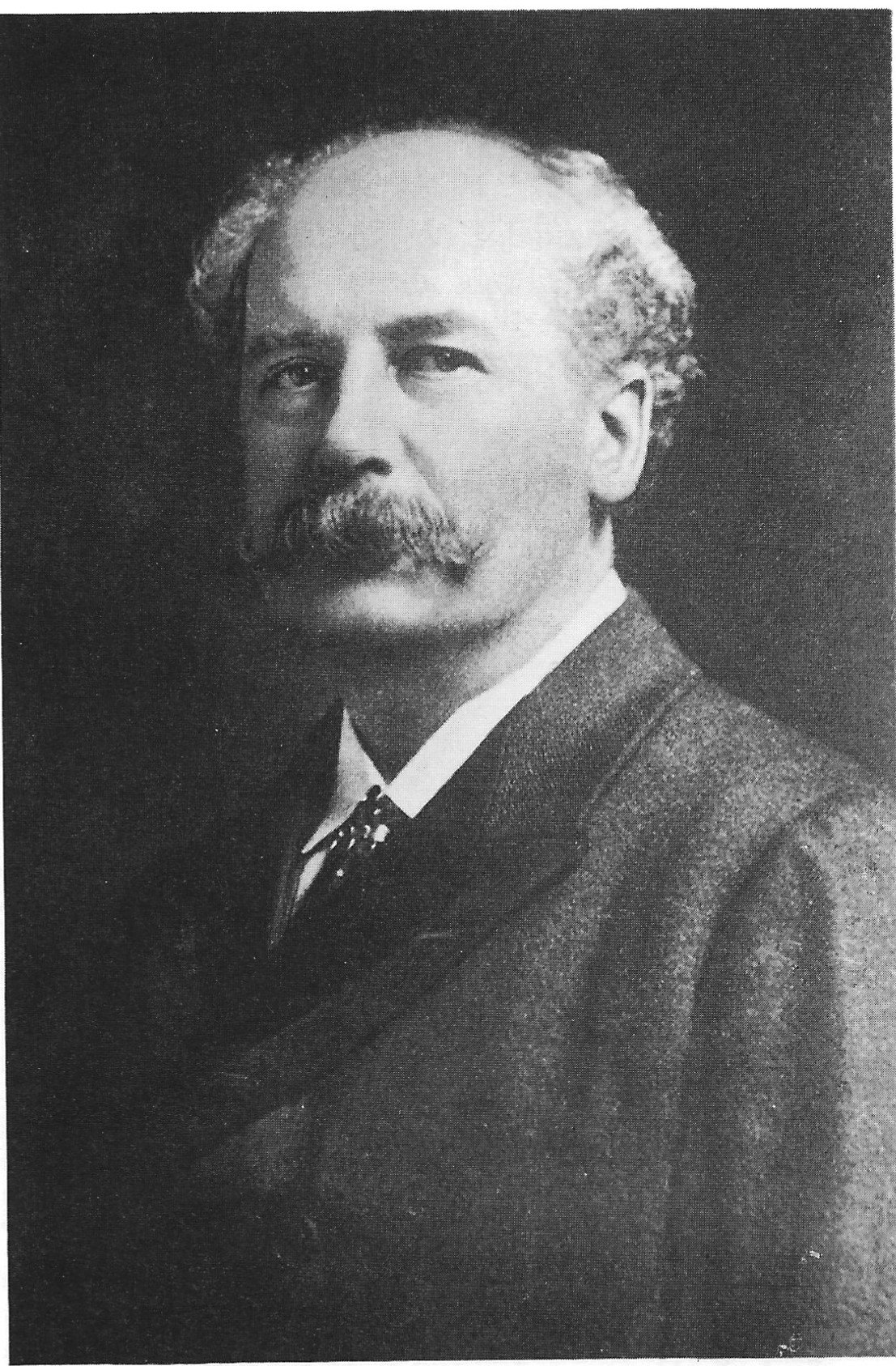
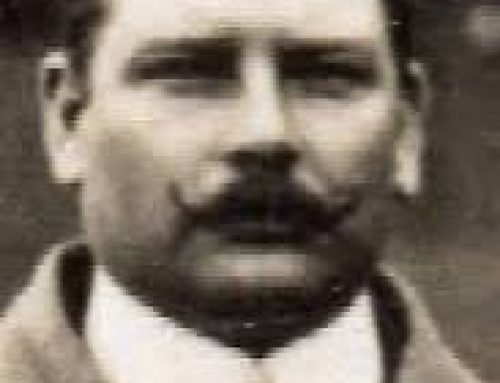
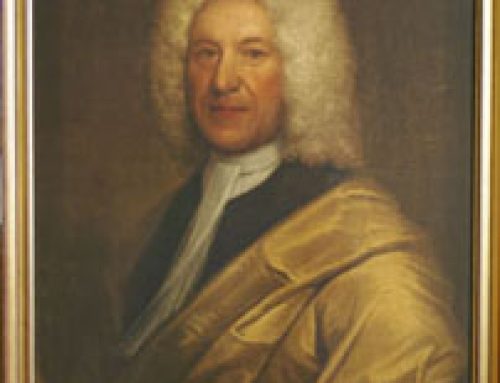
"Founder of A Bilbrough and Company Limited, managers of the London Steamship Owners’ Mutual Insurance Association Limited "
Early Life and Career
Arthur Bilbrough was born in Leeds in 1840 to a well-established Yorkshire family. He was the first child of Brooks Priestley Bilbrough and his wife Anne nee Lister. The middle name of his father records a connection to Joseph Priestley, discoverer of oxygen.
Arthur left school in 1856 and joined the Liverpool office of a firm called Pilkington Wilson, owners of the White Star Line. After completing his apprenticeship he moved to London with a friend, Albert Cook, and in 1862 formed a company called H T Wilson Cook. Henry Threlfall Wilson was a driving force behind the White Star Line and, as Bilbrough commented, he ‘…was my master and now my partner’. Arthur Bilbrough’s was not a rags to riches story. Rather it confirms the aphorism that the best way to make a large fortune is to start with a small fortune. He did so by borrowing £1,000 from his uncle Lister (approximately £100,000 in today’s money) to start the business. Initially, it handled the London sailings of White Star Line ships. On the death of Cook the firm became Wilson Bilbrough.
The 1860s were to prove a very busy time for Arthur both professionally and domestically. His business flourished to the extent that, by 1865, he was able to repay the £1,000 his uncle had lent him, and within 10 years Arthur Bilbrough had bought four of the White Star Line’s ships. The company expanded into shipping insurance.
Marriage and a Move to Twickenham
On 9 July 1863 Arthur married Agnes Hodgson, daughter of one of the founders of the Royal Bank of Liverpool. Domestic life began in South Norwood, then a brief stay at Sudbrook Cottage in Petersham, and on 2 August 1865 they moved with their son Albert to 3 Bridgefield Villas, East Twickenham. Their second son Harold was born at Bridgefield Villas in 1867. The family moved to Rosslyn House, (illustration) Twickenham Park, a short distance from Bridgefield Villas, in June 1868 where their third son, Kenneth Leslie, was born in 1871. The 1871 Census shows Arthur, Agnes, sons Alfred and Harold, Arthur’s mother-in-law and sister-in-law, and 3 servants.
The business continued to flourish and in 1879 Arthur set up a new company, A Bilbrough and Company, which had a fleet of 13 sailing ships. This had grown to 34 by 1909 including a ship called ‘Teddington’.
The family seemed prepared to move on a regular basis. Arthur’s diary for 4 June 1873 states: ‘Moved into Heath House Twickenham taking the last 4 years of C A Hardman’s lease’. And, approaching the expiry of that lease, the diary entry reads: ‘Moved into Inverness Lodge, Pope’s Grove, Twickenham.’
There was time for leisure: the diary entry for 20 August 1872 reads: ‘Went to Oxford with Agnes… and rowed down in our own boat to Twickenham’. According to the diary this energetic exercise was repeated in April 1885.
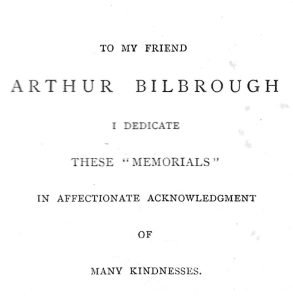
Bilbrough book dedication
In 1872 Arthur Bilbrough appears as the dedicatee of ‘Memorials of Twickenham’ by Rev R S Cobbett. Cobbett was curate at St Mary’s Church Twickenham from 1866 to 1872 so perhaps they became friends through the church.
As befits a prosperous Victorian man of business, civic duty called. On 17 May 1881 Arthur was elected to the Twickenham Local Board and in November that year he: ‘Took an engineer to sewage works to see if there was engine power enough to light Twickenham by electricity.’ There’s no further comment in the diary but this visit may have been in anticipation of the Electric Lighting Act 1882 which enabled the Board of Trade to authorise local authorities to install a supply of electricity. His diary for 9 April 1884 records that he was not elected to the Local Board but in November that year he was ‘Elected to the Twickenham Free Library Council.’
A diary entry for 3 October 1880 records that Arthur ‘Read ‘True Under Trial’ to the children at the Police Orphanage’ with a further reading the following October. The Metropolitan and City Police Orphanage stood in Hampton Road, Twickenham very close to where Arthur was to move a few years later.
Builds ‘Thurnby’
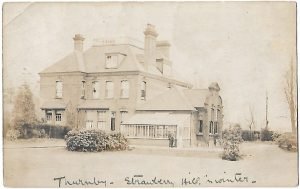
Thurnby. Wellesley Rd junction with Spencer Road.
Domestically the later 1880s were dominated by a further house move, perhaps motivated by a desire to have a more permanent home. In quick succession diary entries record in March and April 1886 ‘Opened tenders for building ‘Thurnby’. Rose highest of 15 £2,750 Collinson’s lowest £2,200 accepted it’; ‘Measured out the ground at Strawberry Hill’; ‘Signed 99 years lease of piece of land on Sir C Freake’s estate’; ‘Marked out site of house with architect and builder.’
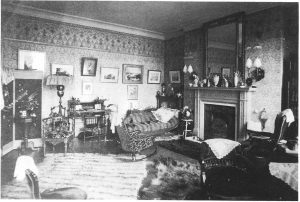
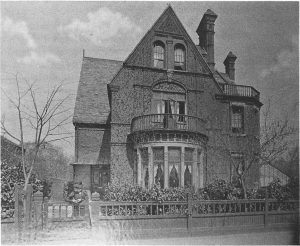
On 7 March 1887 he writes: ‘Moved into ‘Thurnby’ Strawberry Hill which it has taken us 11 months to build’. The house stood at the junction of Spencer Road and Wellesley Road and the site is now occupied by Thurnby Court flats. The 1871 Census shows that Agnes Bilbrough was born in Thurnby, Leicestershire, so this seems a very likely source for the name of the house. The photographs below show the exterior of the house in 1896, and the drawing room in 1892.
Thurnby
Thurnby – drawing Room
In 1897 Arthur was appointed as a Justice of the Peace, sitting for the first time at Brentford in March. Maud Alford, daughter of Vincent Griffiths, a Treasury official and Twickenham resident, recalls that her father sat at Brentford with Arthur Bilbrough: ‘My father and Mr Bilbrough were very keen about temperance, especially, I think, because my mother was ardent about it, and their idea of advancing the good cause was to do nothing to improve the small and stuffy public houses of the place.’
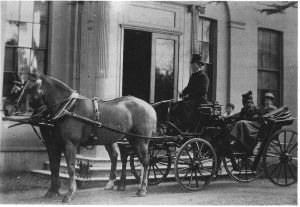
Winton exterior
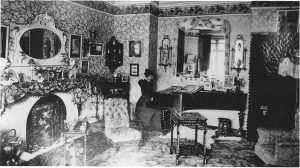
Of theBilbrough sons, Harold Ernest, the middle son, entered the church and went on to become Bishop of Newcastle upon Tyne in 1927. Kenneth Leslie, the younger son, joined Bilbrough and Co. and succeeded his father as senior director. He married in 1897 and settled in Twickenham in a house called ‘Winton’ (no 19 Waldegrave Park). Kenneth moved to a much grander house in Chislehurst in Kent in 1904.
Winton interior
Later Life
The oldest son, Albert William, had a history of poor health and died at the age of 43 in 1908. It may have been this tragedy that prompted Arthur and Agnes to move from Twickenham in November 1908. His diary entry for 4 November 1908 reads: ‘Sold Thurnby to Captain Thompson’ and for 11 November 1908: ‘Last night at Thurnby’. Thompson was one of his old sea captains. Arthur and Agnes moved to Camden Court, Chislehurst, to be near their son Kenneth.
Arthur’s connection to Twickenham didn’t end entirely. His diary records visits to stay ‘at Mrs MacIntosh’s in Twickenham’. In continuation of his interest in social reform, in 1908 he was appointed to the Bishop of London Committee and elected to the committee for the Waifs and Strays (later the Children’s Society); he continued regular visits to the Metropolitan and City Police Orphanage.
Agnes died in 1922 and Arthur in 1925 at the age of 85. The firm he had founded continues to flourish.
Further Reading
‘Bilbrough’, James J McGrane, 1994, ISBN 1 85609 074 4