Alan Turing
Learning: Science and Invention
Alan Turing
Alan Turing
The father of modern computer science
The father of modern computer science
1912 - 1954
1912 - 1954
"Turing test - if the computer's answers could not be distinguished from those of a person after a reasonable amount of time then the machine has some intelligence"
Pioneering work
Alan Turing was an eccentric and pioneering mathematician. Today we consider him to be the father of modern computer science. During World War II he worked at deciphering German codes, first in England (at Bletchley Park) and then in America. After the war he worked at the National Physical Laboratory in Teddington.
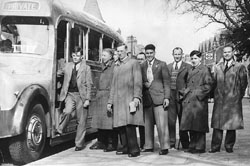
Turing mounting a bus with members of the Walton Athletic Club in 1946
Ones and zeros – the basis of all computer programs
His revolutionary idea was to create a machine that would turn thought processes into numbers. The machine would read a series of ones and zeros from a tape which described the steps needed to solve a problem or task. It took nine years for technology to advance so that a machine could be built to test his ideas – and it worked. Today all the digital computers that we use work on this same principle.

Ivy House, Hampton, Turing’s home from 1945 to 1947
Intelligent machines – the Turing Test
Turing believed that an intelligent machine could be created. In 1950 he described a Test for deciding if a machine could be considered intelligent. The Turing Test: * using a keyboard one person asks questions, * a second person and an intelligent machine both answer the questions, * if (after a reasonable amount of time) you cannot tell the difference between the computer’s answers and the answers of the second person, then the machine has some intelligence.